Factory
The journey of one bag of Abrisham plaster, from quarry to market.
※ Each station has a marked slot for real factory photography and video.
01
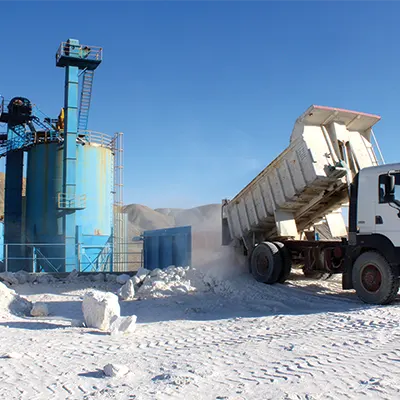
Our own quarry
Gypsum rock comes from the company's own quarry in Semnan province — a deposit known for high purity and natural whiteness. After stripping, high-purity seams are identified and mined mechanically.
≥ 90%
Purity
02
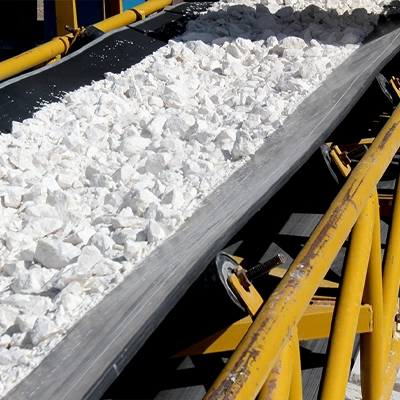
Crushing & sizing
Rock is crushed, sized for an even kiln feed, and impurities are removed — the start of uniform calcining and lower energy use.
≥ 90%
Whiteness

03
Calcining
In modern kilns with controlled temperature and precise residence time, the rock loses its bound water and becomes hemihydrate — the basis of base-coat and finishing plaster.
≥ 85%
Calcium sulfate

04
Milling & micronizing
Calcined plaster is milled and graded through multi-stage sieves; advanced separators produce the micronized grades. The result: more coverage, less consumption.
0%
Residue on 0.5 mm sieve (micronized)
- FACTORY · lab
05
Laboratory
Particle size, setting time, purity, whiteness and compressive strength are tested at several stages in the factory lab, to national and international standards.
5
Quality tests
- FACTORY · packing
06
Packing
Packed in strong laminated bags printed with full specifications and production date, then stored dry. On request: laminated, AD Star and jumbo bags in various sizes.
3
Packaging types
07
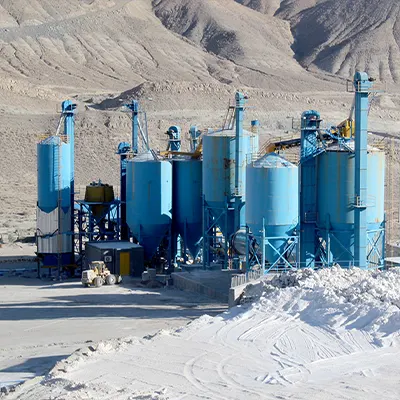
To market
Road, rail and sea freight through Iran's main customs points and ports — Shahid Rajaee, Bandar Abbas, Bushehr, Khorramshahr and Chabahar — to the domestic market and to India, China, Nigeria, Iraq and Kuwait.
5
Export ports